How to Set Up Efficient On-Farm Fuel Storage & Management
Let's be direct: fuel is one of the biggest unmanaged costs on most South African farms. While farmers obsess over input costs, seed varieties, and commodity prices, diesel leaks quietly through the cracks — in theft, in waste, in the wrong tank in the wrong place, in a tractor sitting idle because the fuel bowser ran dry two fields away.
We've walked enough farms to know one thing with certainty: how you store and manage fuel is as important as how much you spend on it.
This is a practical guide, not a product brochure. If you implement even half of what's here, you'll tighten your operation and know exactly where every litre goes.
Why Most On-Farm Fuel Systems Fail
Before we talk solutions, let's name the problem clearly.
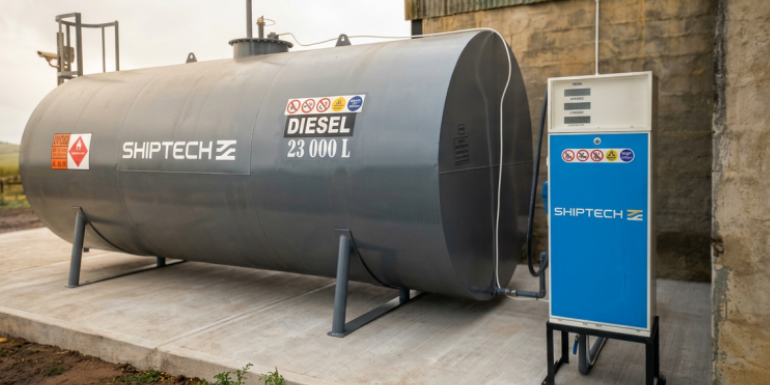
The typical South African farm fuel setup looks something like this: a 2,200-litre or 9,000-litre aboveground tank, a hand pump or aging mechanical meter, an unlocked nozzle, and a paper logbook that nobody fills in after the first month.
The result? By year-end, you're looking at fuel variances of 8–15% with no explanation. That's not a rounding error on a 50,000-litre-per-year operation, that's 4,000 to 7,500 litres unaccounted for. At R24–R26 per litre, you're burning R100,000 to R190,000 in losses you can't see.
This happens not because farmers are careless. It happens because the infrastructure doesn't support accountability.
Step 1: Get Your Tank Sizing Right
The first question isn't which tank, it's how much storage do you actually need?
A common mistake is over-tanking "for security" and ending up with diesel that degrades before you use it. Diesel stored for more than 6–12 months in warm South African conditions starts to lose stability, supports microbial growth, and can cause injector damage in modern common-rail engines, something we see more and more as newer tractors and harvesters arrive on SA farms.
Step 2: Position for Efficiency, Not Convenience
Where you put your tank matters more than most farmers realise.
Get it off the traffic line. The number one cause of tank damage on farms isn't corrosion — it's equipment strike. A tank positioned at the edge of a turning circle or near a workshop entrance will eventually get hit by a trailer or combine header.
Elevation is money. A gravity-fed tank saves pump costs and speeds up refueling. Position your tank on a raised concrete pad minimum 600mm above the highest flood level and you create natural pressure for the dispensing line. On hilly farms, this is easy. On flat terrain, a proper stand structure achieves the same result.
Consider your fleet's geographic spread. On farms larger than 500 hectares, one central fuel point can create unnecessary dead travel. Two or three strategically placed satellite tanks with proper control systems could often deliver better ROI than one central "fortress."
Bunding is not optional. Any tank over 1,000 litres requires a bunded containment area capable of holding 110% of the tank capacity. A fuel spill becomes an environmental liability that follows a farm title deed.
Step 3: Metering — This Is Where the Money Is
If you do nothing else from this guide, implement proper metering.
A mechanical meter is better than no meter. But a digital pulse meter with a resettable counter is better still, and an electronic flow meter integrated with a fuel management system is where serious operations should be heading.
South African farms running electronic fuel management systems routinely report fuel savings of 10–20% in year one, not because they magically use less, but because accountability changes behavior. When an operator knows where every litre is logged against their name or machine number, casual top-ups and after-hours fills stop.
Practical options for SA farms:
- Entry-level: Mechanical meter + locked nozzle + manual logbook (low cost, requires discipline)
- Mid-tier: Digital meter with PIN-based access and local data logging
- Full fleet management: RF card or PIN system with cloud reporting, alerts, and multi-tank support
Step 4: Access Control That Actually Works
A locked nozzle with one key that lives on a nail in the workshop is not access control. It's an alibi.
Real access control means:
Keyed nozzle locks with individual keys per operator, not per shift. When a key is issued to a person, that person is accountable for what's dispensed on their key. Keep a key register.
After-hours fuel protocols. The majority of unaccounted fuel losses happen outside normal working hours. If your system allows fueling at 10pm on a Sunday with no record, it will happen. Either lock the system down physically after hours, or ensure electronic logging captures every after-hours transaction with a timestamp and identifier.
Trusted, accountable designated fuelers. On larger operations, consider assigning fuel management to a specific person whose job includes daily reconciliation. This isn't overhead, it's cost control.
Step 5: Delivery Management — Don't Get Caught Short or Overcharged
The moment your fuel truck arrives at the farm is one of your highest-risk moments for loss.
Always have a calibrated dipstick measurement or electronic level reading before the tanker connects. Record the starting volume. Witness the delivery. Measure again after. Cross-check against the delivery note.
Fuel delivery short-fills are a known problem across South Africa. With diesel prices where they are, even a 200-litre short-fill on a 9,000-litre delivery costs you over R5,000 — and if you're not measuring, you'll never know.
A few non-negotiables for deliveries:
- Always get a signed delivery note with batch number and litres delivered
- Insist on a calibrated truck meter reading at start and end of pump
- Check for water contamination immediately after delivery using water-finding paste on a dipstick — especially in summer when condensation is higher
- Never accept delivery if the truck has a broken meter seal
Your fuel supplier should welcome this level of scrutiny. If they don't, that tells you something.
Step 6: Contamination — The Silent Engine Killer
South African agricultural diesel operates in some of the harshest conditions anywhere — dust, heat, long storage periods, and variable fuel quality from remote depots.
The three contamination risks that damage the most equipment on SA farms:
Water. Condensation in aboveground tanks is unavoidable in coastal and highveld climates. Water settles at the bottom, promotes bacterial growth ("diesel bug"), and enters fuel lines during cold starts when suction pulls from the tank floor. A quality tank with proper breather filters, regular water draws, and biocide treatment prevents this. We recommend a water draw at least every 30 days during high-humidity months.
Sediment and microbial growth. If you're noticing black slime on fuel filters or repeated injector failures, diesel bug is likely the cause. Treat with a registered biocide, clean the tank, and improve your turnover rate. Old diesel sitting in a warm tank is a breeding environment.
Cross-contamination. Petrol into a diesel tank (or AdBlue into diesel) causes serious damage. Colour-code your nozzles and fittings. Use different connector sizes where possible.
Step 7: Monitor, Reconcile, and Report
The farms that manage fuel best don't just measure well at the point of dispensing — they close the loop every week or every month.
A basic fuel management report should answer:
- Litres received vs litres dispensed vs opening/closing stock
- Variance (over or under) expressed in litres and rands
- Usage by machine or cost centre
This doesn't need expensive software. A well-designed spreadsheet with consistent data entry disciplines delivers the same visibility. The goal is to make fuel visible as a managed cost, not a utility that just gets refilled when it runs out.
The Regulatory Reality in South Africa
A note that often catches farmers out: fuel storage is regulated, and the requirements are not as complex as people assume but they do need to be met.
Key frameworks to know:
- SANS 10131: The standard for aboveground storage tanks for flammable liquids. Your tank and installation should comply.
- NEMA (National Environmental Management Act): Spill containment and bunding requirements fall under this. Non-compliance can result in significant liability.
- Municipal bylaws: In some districts, tanks above a certain capacity require notification or approval from the local authority.
A compliant installation isn't just about avoiding fines. It affects your farm insurance policy validity, your ability to secure financing against the operation, and your liability exposure if an environmental incident occurs.
Ask your supplier for a site inspection check list guide before installation. If they can't provide one, find a supplier who can.
Where to Start
If this feels like a lot, start with what you can control this week:
- Measure your current variance. Take a proper dipstick reading today, log every delivery and every dispensing for 30 days, and see what your number looks like. You need to know your baseline before you can improve it.
- Lock your nozzle. If your nozzle isn't locked, fix that today. It costs almost nothing and closes the most obvious loss point immediately.
- Check your tank for compliance. If you have a single-skin tank without bunding, you have both a regulatory risk and an environmental one. Get a site assessment done.
- Talk to a specialist. Fuel storage systems are not complicated, but they need to be designed for your specific volumes, geography, and fleet. Generic advice gets you generic results.
At Shiptech, we've been helping South African operations — farming, mining, construction, and fleet — get control of their fuel infrastructure for years. We don't sell tanks. We engineer solutions around your operation, and we back them with the kind of advice that comes from actually having walked these businesses and know what works in real South African conditions.
If you'd like a site assessment or want to talk through your current setup, get in touch with our team. No obligation — just practical input from people who know fuel.
Get in Touch
Let's Connect. Reach out today to explore our partnership opportunities.
Email us
hello@shiptech.co.za